← projects
BioLoom
A no-signup AI writing tool that generates, scores, edits, and shares platform-specific bios across eight models.
What it is
Problem
Short profile bios are deceptively hard because they compress tone, audience, context, and professional signal into a tiny space.
Solution
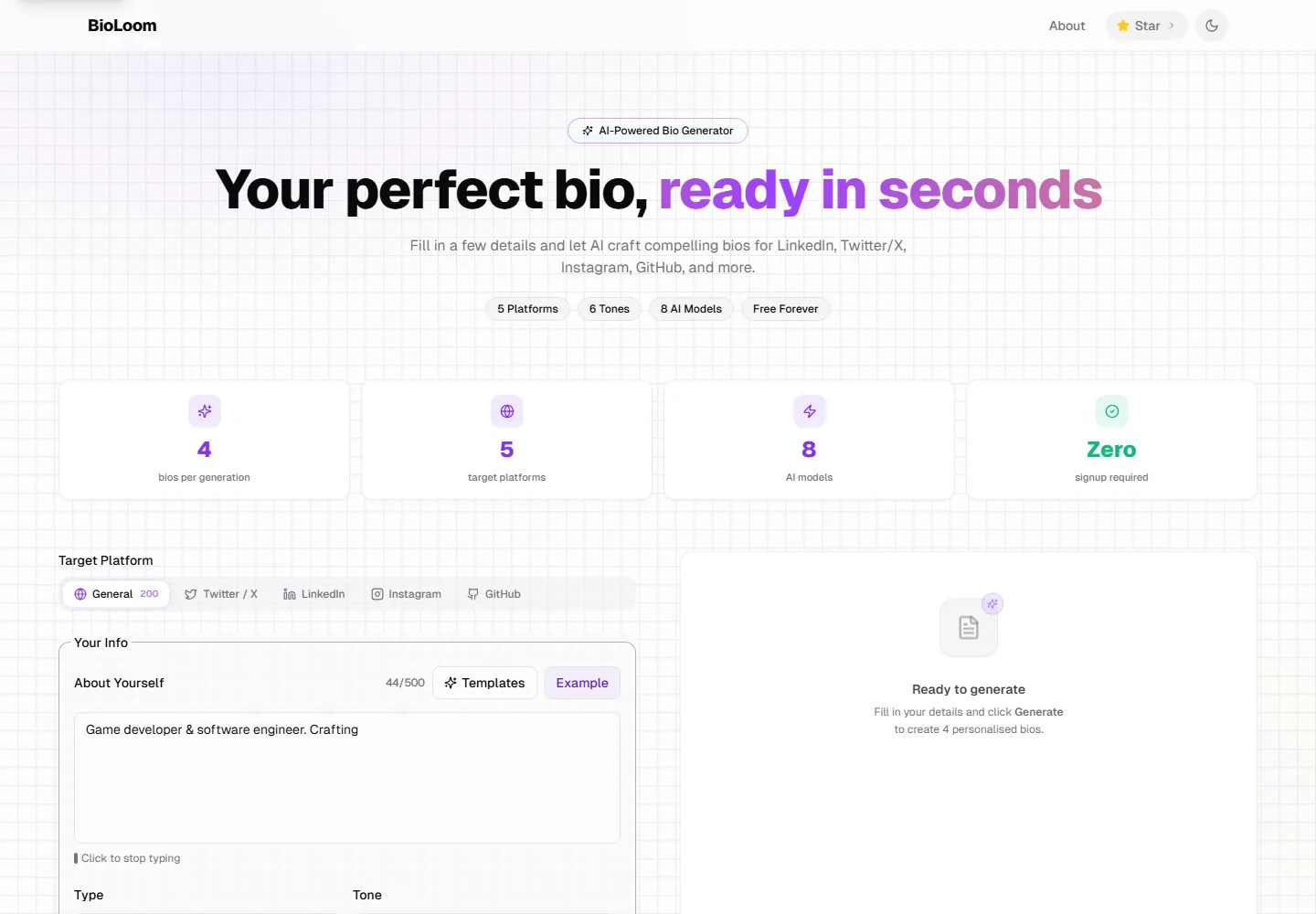
BioLoom turns a guided set of identity, audience, tone, length, and platform choices into four structured options. It streams typed output, scores drafts across five categories, supports inline revision, and falls back across Groq-hosted models and Gemini.
What it looks like
Guided controlsThe form narrows platform, tone, audience, focus, and output constraints before asking a model to write.
Built with
Product
- Next.js 15
- React 19
- TypeScript
- Tailwind CSS
Generation
- Vercel AI SDK 4
- Groq
- Gemini 2.0 Flash
Client state
- Zustand
- localStorage
Highlights
- Four structured bios per generation with streaming presentation
- Eight selectable models across Groq and Gemini fallback
- Five platform presets, six tones, and granular length/temperature controls
- Five-part scoring, revision tips, inline editing, and regeneration
- Share links, text export, command palette, and local history
Engineering
- Process 01
Constrain generation before asking for prose
- Context
- A single open prompt produces bios that vary unpredictably in tone, length, and platform fit.
- Approach
- Collect platform, audience, tone, focus, length, temperature, and emoji preferences before generation.
- Outcome
- Output is more repeatable and editable, at the cost of a longer form than a one-click generator.
- Process 02
Stream structured options, not one text blob
- Context
- Users need alternatives they can compare, score, and revise rather than a single answer they must accept or discard.
- Approach
- Use schema-shaped streaming to return four bios and route provider fallback behind the same result contract.
- Outcome
- The review experience becomes useful across models, while schema adherence and partial-stream handling add implementation complexity.
Under the hood
Architecture notes
- The Vercel AI SDK streams schema-shaped results rather than unvalidated prose blobs.
- Provider selection and fallback are separated from the prompt surface, allowing the same UX to span eight models.
- History and preferences remain local through Zustand persistence; the core tool requires no account.
Challenges
- Making model choice useful without forcing non-technical users to understand provider differences.
- Balancing creative variation with predictable length, tone, and platform limits.
Outcome
A deployed, no-signup writing utility with real model choice, structured output, scoring, history, editing, and sharing rather than a single prompt box.
Roadmap & lessons
Lessons learned
- 01Good AI tools narrow the decision space before generation.
- 02Small tools still need strong typography and empty states.
Next steps
- 01Add multilingual scoring examples
- 02Expose clearer model trade-offs
- 03Test accessibility with longer generated output